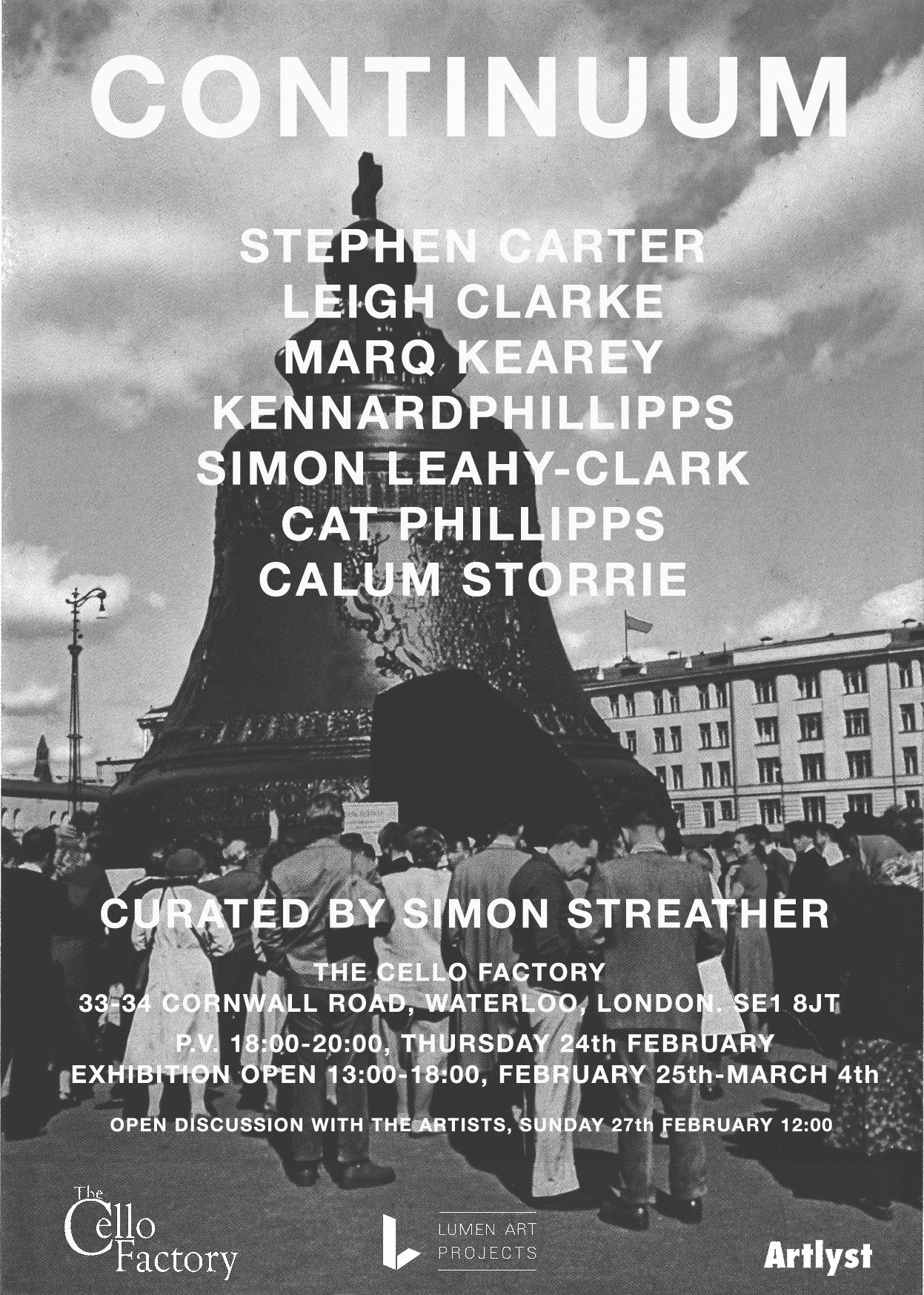
Below is the exhibition text by curator Simon Streather for ‘Continuum’ at the Cello Factory, London, which closes on Friday 4th March.
The artists represented in this exhibition consider what it is to exist within the continuum of production and consumption that marks contemporary life. The artworks are derived from what is often overlooked or discarded. We are asked to consider the detail of material with an assumed short shelf life. The continuum of practice and process returns a sense of agency amidst a deluge of anonymously generated yet manipulative information and misinformation.
Works presented span over twenty years of engagement, some have been made specifically for this exhibition, or are being shown for the first time.
In the collaborative works of kennardphillipps the intent of mass produced media is subverted in a quest to uncover. The results are often manifest outside the confines of a gallery as publications or street interventions. Both in the making and presentation these counter ubiquitous models of art production and value systems. They are presenting an installation made for the exhibition reflecting on the current British political situation. In prints from their ‘Cafe of equivalent$’ project, pictures of two different worlds are superimposed. Over stacked columns of share prices are printed images of impoverished workers. These images could be taken from different pages of the same newspaper, they are depictions of the one world we inhabit.
Mark Kearey has replicated London street advertising for many years. What was an immediate response to his surroundings has entered into a realm of peripheral collective memory. Here he shows small drawings created on scraps whilst travelling. They depict giants of food manufacturing industries. These diminutive drawings seem like a gesture from David to Goliath, a slingshot made with what is available. The wrapping and packaging of foodstuff is replicated in another painted collage, it shows the hypocrisy underlying what is hidden and revealed.
In the intricate collages of Simon Leahy-Clark often unnoticed details of clipped newspaper images re-form. On close inspection these fragments reveal clues to their place in a previous presumably driven narrative. Yet they don’t resolve into a clearly decipherable image or text, rather remain suspended in an inchoate pre-linguistic state, forming suggestive new collusions in the darkness. In another ongoing series ‘Reduction/Redaction’ he concentrates on meticulously removing the noise of word and image from whole newspapers. This results in a fragile lattice of what the artist terms “accumulated absence”, which paradoxically becomes a new physical presence. Like many of the artists presented, the serial nature of works suggests both endurance
and a delicate balance between insistence, variance and exhaustion.
The paintings of Stephen Carter seem to abjure commentary. Rather like the work of a scribe his replications and repetitions can be seen to reveal mechanics of power through what is omitted as much as what is present. Words edited from mass media hover alongside each other inviting the viewer to create new readings. The words retain the titillating nature of their tabloid origins despite their austere ghostly rendering. Messages meant for a moment attain the status of artworks, the words then both accumulate and lose meaning as they persist. Recent paintings forgo the traditional stretcher support. These remnants suggest questions of choice and visibility. Whist still retaining some sense of the scriptural they also tempt a purist reading.
Calum Storrie focuses on the nature of interpretation and notation by making musical scores. In these scores hand drawn authorial lines trace their way through found and collaged elements. This material is then freely interpreted by a musician. The visual is not an end point here, rather a point on the way and a spur or cue to a mutable, temporal and ineffable result. Unknown original contexts recombine, set for an unknown destination, perhaps indicating the impossibility of finite completion. Storrie is an archaeologist of the present, attuned to the incumbent nostalgia and potential hopefulness this entails.
Cat Phillipps presents a composite work of portraits, part of an ongoing series. The one defining element of a portrait is missing: recognisability, the main index of portraiture’s celebration. These are portraits of a type, the man in a suit, possibly an architect of our current malaise. The anonymity and opacity granted to agents of injustice is at stake. The images crease, slip and slide back into transparency through processes which are mechanical, entropic and haptic. These quasi paintings suggest the salutary inescapable reality of mortality, alongside an awareness that even annihilation leaves its trace.
Leigh Clarke shows prints from a large series entitled ‘Human Stain’ when amassed they assume a challenging presence. Although he is a highly skilled printmaker he has eschewed expertise in favour a direct immediate approach, even abandoning the printing press in favour of his own body-weight. The performative act, key to many works, seems especially evident here. The prints suggest potentially endless reconfigurations. Made with sponges, the very things supposed to clean the vehicle, body or printing plate, become those which sully the paper to make an irrevocable image. As he has said “The sponge is a quick learner.” Perhaps this simple tool
mirrors the sophisticated matrix of algorithms which is the web. Although results, inclinations and objectives differ, these artists share in expressing a relation to
contemporary life. This is articulated with a restraint and constructive economy of means where creation is seen in part as editing, erasure and arrangement. The inherent fragility of the different ways these works assert their presence in the world portrays the temporal contingent life of objects and gestures.
Simon Streather, January 2022.
 Simon Leahy-Clark